A Patient-Facing AI Health Advocate,
Multiple Custom Trained Ai Models, Nutrition Emphasis, and Personal Health Records
The Patient pillar of the Three Pillars framework. A consumer
health portal with 25+ lab panels (reference ranges and longitudinal
trends), an AI educational assistant for general lab information and lifestyle
education, a library of over 50,000 MAHA-curated recipes with dietary and
allergen filters, and a meal planner that rolls into an aggregated grocery cart.
Ai extraction of health data directly from de-identified records; direct device integration with
Apple Health, Oura, Whoop, Garmin, and Dexcom — via webhooks and API —
on the roadmap. Uploaded records pass through our de-identification pipeline
before any AI processing, and your data is stored locally in your browser by
default.
Privacy-first architectureCustom-trained modelsYour data stays yours
The Three Pillars
NexGenHealth.io is organized around three interconnected audiences bound by a single
commitment: non-invasive tracking, evidence-led
education, and patient-owned data. Each pillar has a distinct role. Together they
describe how NexGenHealth.io is designed to operate — research informs the
educational tools the portal provides, patients retain ownership of their data at every
step, and the data a patient shares helps inform conversations with their clinician. Some pieces are shipped
today; others are in active development — see each pillar card below.
Researchers — Originate the evidence
Scientists developing non-invasive monitoring technologies, AI-driven nutrition research, and chronic-disease prevention protocols. Over time, their findings shape the tools, recipes, and monitoring approaches available in your portal.
Custom LLM tools and curated literature aggregation (subscription)
Non-invasive monitoring research focus
Coalition with consenting providers and patient cohorts (in active development)
Your clinicians. The Provider Portal is in active development. Once shipped, your doctor will be able to receive the context you choose to share — uploaded labs, supplement list, longitudinal vitals, dietary adherence — on architecture designed to keep your health data on their perimeter. Today, you can already export a ZIP with a plain-language privacy summary and hand it to them at the visit.
Pre-visit summary from your consenting share (ZIP export shipped; direct integration in development)
Local-AI architecture — de-identification pipeline already runs on the VPS; clinician-facing UI in development
Research findings surfaced for your reference (in development)
You. Tracking vitals and labs, generating meal plans from a large recipe database with dietary and allergen filters, and choosing — on your own terms — what context to share with your clinician.
25+ lab panels with reference ranges and longitudinal trends
library of over 50,000 MAHA-curated recipes with dietary, allergen, and NOVA-level filters; aggregated grocery cart with one-tap grocery-delivery integration
ZIP data export with a plain-language privacy summary today; direct portal-to-portal integration on the roadmap
The Free Portal is the patient-facing surface of a custom-built AI
platform. Eight integrated tools, each powered by models trained or tuned
specifically for the data they see — so the assistant helping you with diabetes
isn’t the same generalist model trying to help someone else write a birthday card.
Vitals Tracking
Manual entry today for blood pressure, heart rate, weight, blood glucose, HbA1c, and temperature — with computed BMI, BMR, and TDEE surfaced automatically. Wearable-linked entry (Apple Health, Oura, Whoop, Garmin, Dexcom via webhooks/API) on the roadmap.
Blood pressure, heart rate, glucose, HbA1c, weight, temperature
Computed BMI / BMR / TDEE with trend lines
Timeline view across weeks and months
Metabolic Health & Labs
A 40-plus blood-marker reference library fused with your uploaded lab panels. Inflammation, lipid, glycemic, thyroid, and micronutrient markers mapped to plain-language insights.
Energy-metabolism summary with actionable guidance
Biomarker reference database with clinical context
Chronic Condition Tracking
Record diabetes, prediabetes, hypertension, cardiovascular conditions, and mental-health conditions with ICD-10 coding, severity staging, and treatment status (Pro plan). General educational summaries and visit-prep questions are in development.
ICD-10 coded diagnoses with severity and status fields (Pro plan)
Symptom and biomarker tracking per condition
Condition-specific educational content
AI Health Assistant
A chat assistant for health questions, lab-result explanations, and lifestyle guidance. Ask about your glucose trend or your last lipid panel. Responses are informational and educational only — not a substitute for professional medical advice, diagnosis, or treatment.
Health questions and lab interpretation on request
Multi-turn chat with prompt history
Disclaimer on every response: consult your clinician for medical decisions
Meal Planning & Recipe RAG
Semantic search across a 436K-plus recipe corpus using a custom vector database. Meals are filtered by your dietary profile, allergens, and health conditions — not suggested at random.
436K+ recipes indexed with pgvector semantic search
Dietary / allergen / condition-aware filtering
3-day free plans; 1, 3, 5, or 7-day plans on paid tiers
Grocery & Delivery Integration
Meal plans roll straight into an aggregated grocery cart, then into a grocery-delivery service with dietary filters applied — vegan, gluten-free, kosher, sugar-free, low-fat, organic. One tap to shop.
Auto-aggregated ingredient list with completion tracking
One-click delivery-ready shopping lists and recipe pages
Pantry-aware exclusions so you don’t reorder what you have
Medical Records & De-Identification
Upload lab PDFs, imaging reports, or visit summaries. Our de-identification pipeline extracts 40+ blood markers and conditions — without exposing your identifiers to downstream processing.
Direct identifiers redacted on ingest, before any model sees the content
Automatic extraction of labs, meds, and diagnoses
Encrypted vault: 40 GB (Basic) / 80 GB (Pro)
Health Calendar & Regimen
A single timeline of meals, medications, cardio sessions, and appointments. Tag, review, and reason about your last 30 days in seconds — so patterns become visible.
30-day rolling pattern view for the assistant to reason over
Why Custom-Trained AI Matters for Your Health
Generic chatbots don’t know your HbA1c. They don’t know that your last magnesium draw was low, that your glucose spikes after oatmeal, or that your father has cardiovascular disease. NexGenHealth builds and tunes models specifically for the data they see — because health is the domain where generic is not good enough.
01 Intelligence Built for You
Grounded Health Assistant
Answers from your record, not the internet.
The AI Chat tab is wired directly to your vitals, labs, conditions, and logged meals. When you ask “why did my fasting glucose jump last Tuesday?” it reasons over your actual data — not a generic FAQ. Multi-turn memory, sourced citations, and hand-offs to clinical resources when the question falls outside safe AI scope.
A custom-curated 436K+ recipe corpus embedded in pgvector, searched with hybrid sparse + dense retrieval. Dietary style, allergens, macro targets, and flagged chronic conditions all become hard filters — so “low-sodium, diabetic-friendly, Mediterranean” returns only recipes that actually match.
Upload scans your labs through a de-identification pipeline built on the Stanford-AIMI de-identifier. Names, addresses, record numbers, and account numbers are redacted before extraction; dates are adjusted through an internal offset so your trends stay analyzable. Biomarkers and diagnoses are surfaced to your dashboard automatically.
Educational context shaped by the conditions you log.
Log a condition — diabetes, hypertension, CVD, mental-health diagnoses — and the platform reorganizes around it: biomarker priorities shift, meal filters tighten, and the assistant surfaces general educational information related to the conditions you record, rather than only generic wellness content.
Dashboard scaffolding built for Apple Health, Google Fit, Oura Ring, Whoop, Garmin, and Dexcom / Libre continuous glucose monitors. Direct streaming via webhooks and API is on the roadmap; once shipped, heart rate, sleep stages, activity, HRV, SpO2, and glucose will land in a single timeline where the assistant can reason across them simultaneously — not siloed inside four separate apps.
Apple HealthOura / WhoopCGM readyTimeline fusion
Vitals & Metabolic Dashboard
BP, HR, glucose, HbA1c — in one trend view.
Track vitals through manual entry today — wearable import is on the roadmap. BMI, BMR, and TDEE are computed from weight and activity; HbA1c is estimated from your glucose log; lipid ratios are derived from your uploaded labs. Each metric carries a reference range and a trend arrow so anomalies are immediately obvious.
The Regimen tab captures cardio duration, intensity, and perceived exertion alongside meal logs. Correlate your training load with next-day glucose, resting heart rate, and HRV — the feedback loop lifestyle medicine has been asking for, with the data infrastructure to actually close it.
Daily meal logging with macro and micronutrient breakdowns. When paired with CGM data, the platform builds a personal glycemic-response profile — the foods that spike your glucose aren’t necessarily the foods that spike someone else’s. Tailored, not templated.
Macro trackingMicronutrientsPersonal glycemic responseMeal ↔ vitals link
03 From Diagnosis to Doorstep
One Loop: Condition → Meal Plan → Cart → Delivery
A logged diagnosis becomes a delivered grocery order — without you stitching six apps together.
Chronic IllnessLogged in profile
›
Custom Meal PlanCondition-aware RAG
›
Ingredient ListPer-recipe, scaled
›
Shopping ListAggregated, deduped
›
Auto CartInstacart populated
›
Grocery DeliverySame-day to your door
Log a chronic condition once and the platform threads the rest. The 60K condition-aware recipe set narrows the candidate pool to meals whose macro profile, ingredient quality, and cooking method align with your diagnosis — hypertension steers toward low-sodium, type 2 diabetes toward low-glycemic, hyperlipidemia toward heart-healthy fats. The week’s plan generates from that pool, then each recipe’s ingredient list flows automatically into a unified weekly shopping list: quantities aggregated across recipes, duplicates collapsed, pantry staples optionally suppressed. From there, one tap pushes the list straight into an Instacart Connect cart, with retailer-specific SKUs already bound by an internal ingredient-to-retail map. Review, swap, checkout. Same-day delivery handles the last mile, and the meals you planned on Sunday morning arrive at your door before you cook them on Tuesday night.
Inside the meal planner sits a condition-aware recipe database — a condition-aware subset of the MAHA-curated library, redesigned to swap out ingredients flagged by the MAHA movement (synthetic dyes, BHA/BHT, BVO, partially hydrogenated oils, and other additives federal regulators are actively phasing out) and engineered around the dietary considerations of the ten most common chronic conditions in the United States. When the meal planner builds your week, it draws preferentially from this set if you have a relevant diagnosis logged.
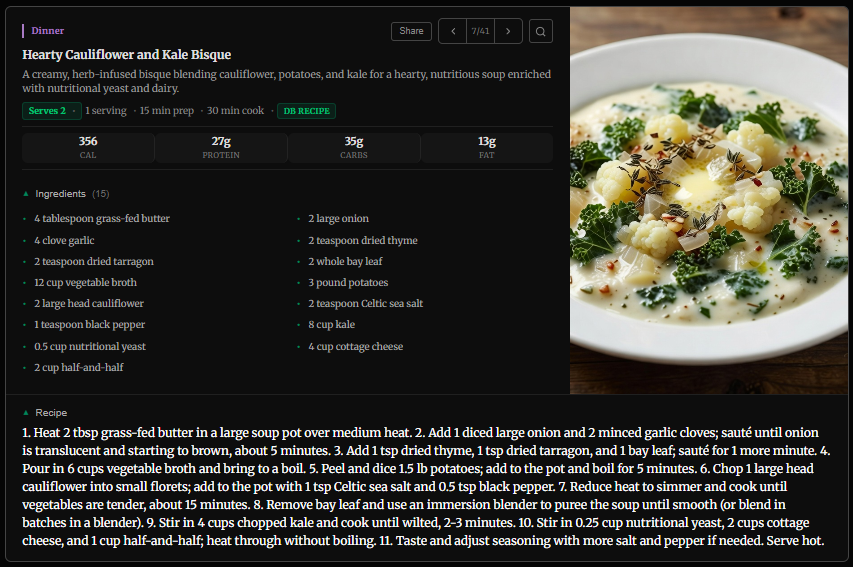
Hearty Cauliflower and Kale Bisque — a real card from the portal’s meal planner. Grass-fed butter, vegetable broth, cauliflower, kale, nutritional yeast, cottage cheese. 356 cal, 27g protein. Database recipes have been carefully generated from open source recipe databases and validated through explicit verification processes to ensure accuracy, quality, and precision
Anatomy of a meal card
Every card in your generated plan opens with the meal type (Breakfast, Lunch, Dinner, Snack), the recipe name, and a short description — followed by serving size, prep time, and cook time on the meta row. A green DB RECIPE badge indicates the recipe came from the curated database rather than being generated on the fly. The macro tiles directly underneath show calories, protein, carbs, and fat at a glance so you can size the meal against your daily targets without opening the full breakdown.
Below the macros, the full ingredient list — with quantities scaled to your selected serving count — sits next to the step-by-step recipe instructions. The header strip carries the controls you use to act on the card: a Share button (top-right) opens a small menu to send the recipe to a household member by email or push the meal into your calendar with prep and cook time blocked out, so a week’s plan turns into a week’s schedule in one tap. Adjacent to Share, the pagination chevrons (e.g., 7/41) let you step through every meal in the plan, and the magnifier icon scopes search inside the plan when you’re looking for a specific recipe.
The ten chronic conditions the recipe library is engineered for
Per CDC and NHANES prevalence data, these are the chronic conditions that drive the largest share of U.S. healthcare spend and adult morbidity. The 60K curated subset prioritizes recipes whose macronutrient profile, ingredient quality, and cooking method align with the dietary considerations clinicians typically recommend for each:
Hypertension
Hyperlipidemia (high cholesterol)
Type 2 diabetes & prediabetes
Cardiovascular disease
Obesity
Chronic kidney disease
Chronic respiratory disease (COPD, asthma)
Arthritis (osteo & rheumatoid)
Cancer-survivorship nutrition
Depression & anxiety
If you log a diagnosis in your portal, the meal planner factors that condition into its filter pass — alongside your dietary style, allergens, calorie target, and store preferences — so the recipes that surface are the ones engineered for what you’re actually managing.
Local Food Sourcing — From Your Region to Your Meal Plan
The next layer of the meal planner is a regional food-sourcing
coalition — direct collaborations with local farmers, weekly farmers’
markets, and pasture-raised poultry and grass-fed beef ranchers in your area —
with a direct-to-door delivery layer functionally similar to Instacart but routed
through local producers instead of national chain retailers. Status: on the
roadmap; not yet integrated. Once shipped, your weekly meal plan will resolve
ingredients first against the regional supply, then fall back to standard grocery
delivery for what isn’t locally available.
Local Farmer Network
Direct partnerships with regional farms growing produce, leafy greens, root vegetables, and seasonal crops. Your meal-plan ingredient list resolves first against the farms within delivery range — so the same recipe that would otherwise pull a long-haul tomato draws from a farm twenty miles away when in season.
Regional farm partnerships with seasonal availability
Crop-level provenance per ingredient
Recipe-to-farm matching at meal-plan generation
Farmers’ Market Integration
Weekly farmers’-market schedules, vendor lineups, and current-week inventory pulled directly from participating market organizers — so your shopping list can route through Saturday morning at the local market instead of the supermarket aisle, and the platform tells you exactly which stall has the rainbow chard you need.
Live market schedule and vendor manifests
Stall-level item availability
Pickup-route planning with prep-time alignment
Pasture-Raised Poultry & Grass-Fed Beef
Direct sourcing partnerships with regional ranchers and small-scale poultry producers prioritizing pasture-raised, grass-fed, and regenerative-grazed protein — aligned with the MAHA movement’s emphasis on cleaner protein quality and the FDA’s active phase-outs of additives in conventional supply.
Pasture-raised poultry from regional small farms
Grass-fed and regenerative-grazed beef
Producer-level provenance and processing transparency
Direct-to-Door Local Delivery
An Instacart-style direct-to-door layer routed through local producers instead of national chain retailers — so the same one-tap experience that fulfills a standard grocery cart can also fulfill a farm-direct, market-direct, or rancher-direct order. Same ingredient flow, same checkout; cleaner supply chain. Not yet integrated; on the roadmap alongside the broader regional-supply build.
Last-mile logistics for local producers
Unified checkout across local + standard grocery
Same-day or scheduled delivery windows
Chronic Condition Tracking & Education
Six in ten U.S. adults live with at least one chronic condition, and four in ten live with two or more. The Centers for Disease Control identifies heart disease, cancer, diabetes, chronic kidney disease, and mental-illness conditions as the leading drivers of the $4.5T annual U.S. healthcare spend. These are data-driven illnesses — and they respond to data-driven self-tracking and education.
📝
Log a Diagnosis Properly
ICD-10 coded entry for each condition, with severity stage, treatment status, and start date. Your record reflects reality — not a freeform note.
📊
Watch the Right Biomarkers
The platform highlights the lab values that actually matter for your condition — HbA1c and fasting glucose for diabetes, LDL and ApoB for CVD, eGFR for kidney disease — instead of a wall of numbers.
📚
Education On Demand
Ask the assistant to explain your diagnosis, your meds, or the difference between Type 1 and Type 2 diabetes. Answers cite authoritative medical sources; nothing is fabricated from generic web text.
📍
Shareable With Your Clinician
Export a timelined, de-identified summary for your next visit — labs, vitals, symptoms, adherence. Your 15-minute appointment becomes a targeted conversation instead of a chart-review.
The Evidence Behind Personalized AI Health
A scan of the peer-reviewed literature from 2020 onward on AI in precision health, synthesized from the references listed at the bottom of this page. Your subscription is grounded in the same research.
Precision Nutrition
Nutrition is central to chronic-condition wellness — diabetes, cardiovascular disease, obesity, and inflammatory conditions all relate to diet. A ScienceDirect scoping review reports a significant rise in AI-driven precision-nutrition research since 2020, with ~75% of studies focusing on diet-related diseases [1]. Published in Scientific Reports, deep generative models can now produce weekly meal plans tailored to a patient’s anthropometrics and diagnoses [2]. Nutrigenomics — how genes affect nutrient metabolism — further refines these recommendations [3].
Table 1 · AI Applications in Personalized Nutrition
Supplements correct real deficiencies and support clinical goals — but off-the-shelf regimens are a guess. AI platforms such as Supplement AI and Bioniq analyze individual health data to generate tailored regimens [6][7]; Bioniq updates its formula every six months based on biomarker drift. Cross-reference any AI-suggested regimen with your clinician before starting — individual response varies.
Table 2 · AI Platforms for Personalized Supplementation
Platform
Data Inputs
Features
Ref
Supplement AI
Health metrics, dietary habits
Bias-free supplement insights
[6]
Bioniq
Health quiz, blood tests
Hyper-personalized granules, 6-month updates
[7]
Nourished
AI-enabled quiz
3D-printed gummy vitamins
[8]
Local, Sustainable Food Sourcing
Locally sourced food is fresher, more sustainable, and supports the regenerative farming movement NexGenHealth is aligned with. AI meal-planning tools now factor seasonality and geography, generating recipes that favor what’s actually at your local grocer or farmer’s market [5][9][10].
Table 3 · AI Tools Supporting Local Food Sourcing
Tool
Functionality
Local Sourcing Feature
Ref
AI Meal Planner
Personalized meal plans
Seasonality-aware
[5]
FoodiePrep
Recipes from on-hand ingredients
Links to local grocery stores
[9]
NexGenHealth Meal-to-Cart
Meal plan → filtered shopping list
One-tap local fulfillment via grocery-delivery partners
This platform
Non-Intrusive, Lifestyle-First Treatment
Lifestyle medicine — diet, exercise, sleep, stress management — is the leading edge of modern chronic-disease care. A Cureus narrative review highlights AI’s role in real-time dietary assessment and tailored behavior-change interventions [11]. Platforms like Lyfy layer personalized coaching on top of lifestyle data to prevent or manage type 2 diabetes and cardiovascular disease [12]. CBT chatbots scale mental-health support into between-visit windows where traditional care is silent [11].
Table 4 · AI in Non-Intrusive Treatment
Application
Functionality
Health Focus
Ref
Lyfy
Personalized AI coaching
Chronic-disease prevention
[12]
BitHabit
Incremental lifestyle changes
General wellness
[13]
AI-driven CBT Chatbots
Scalable mental-health support
Stress & anxiety
[11]
Continuous Monitoring via Wearables
Wearables and continuous sensors — smartwatches, rings, chest straps, continuous glucose monitors — have turned health into a stream of signals instead of an annual snapshot. A PMC review documents the rise of AI-based wearable sensors for continuous monitoring and early diagnostics, especially in diabetes and heart disease [14]. Cedars-Sinai research projects that AI-driven wearables will become standard care, alerting physicians to early disease signs long before a symptomatic visit [15]. Apple’s health-coaching features point to where the industry is headed [16].
Table 5 · AI-Powered Wearables in Healthcare
Device / Application
Monitored Metrics
Benefits
Ref
Cedars-Sinai Wearables
Glucose, heart rate, blood pressure
Early disease detection
[15]
AI-Based Sensors
Activity, sleep, vital signs
Continuous monitoring
[14]
Apple Health Coaching
Apple Watch data
Personalized advice
[16]
NexGenHealth Dashboard
BP, HR, glucose, HbA1c, HRV, sleep
Unified timeline + grounded AI assistant
This platform
Your Data. Your Health. Your Privacy.
The hardest part of consumer-health AI isn’t the model — it’s the stewardship of the data that goes into it. We design for the audit before we design for the demo.
🔒
Privacy-First by Default
Direct identifiers redacted on ingest before any downstream model sees your content. Dates adjusted through an internal offset so longitudinal trends remain analyzable. Row-Level Security on every database table, with role-restricted access controls.
🛡
Defense-in-Depth
TLS 1.2+ only, non-root service accounts, UFW-hardened firewalls, fail2ban, authenticated Redis, identifier-scrubbed error paths — a defense-in-depth security posture, delivered to a consumer portal.
📊
Evaluated, Not Assumed
Our de-identification pipeline is measured against a 13,808-record synthetic benchmark corpus, not against live user uploads. We track per-identifier recall (currently 98.5% overall), coverage across the 18 identifier categories defined at 45 CFR § 164.514(b)(2), and the rate at which non-identifying text is redacted in error. Results and known gaps are recorded for each change, and any change that reduces identifier recall is reverted. Where an identifier is only partly removed, what remains is a label prefix rather than an identifying value. We are not a HIPAA covered entity and we cite that identifier list as a technical specification, not a compliance claim.
🌐
Data Sovereignty
Export-ready at any time. Your data is portable; your record is yours. Cancel the subscription and walk out with a clean JSON archive of everything you logged.
🔍
No Model Training On You
Your data is never used to train third-party foundation models. Our custom models are trained on licensed, de-identified corpora — not on subscribers.
📜
Documented, Not Folklore
Architecture, API map, environment matrix, and alerts — every service ships with the documentation we use internally. If you ever audit us, we’ll hand you the same binder we use ourselves.
Take Control of Your Health
Start with the free portal. Upload a lab, log a meal, ask the assistant a question — all without a credit card. Upgrade when the platform has earned it.